Basis Points in Finance and How to Calculate Basis Point to Percentage
Harvey Feriors
Editor
Published
Modified
Harvey Feriors
Editor
Published
Modified
Basis Point is a unit for describing the percentage change, mostly used in financial and investment terms, especially to describe how many percent of interest rate or policy rate has changed. 1 Basis Point is equal to 0.01% (of a changed percent).
In economic or investment news you might see “basis point” in a headline like “The Federal Reserve cut the policy rate by 25 basis point”, this means the Federal Reserve reduced its policy rate by 0.25% (maybe from 1.75%-2% to 1.5%-1.75%).
Many times, you’ll see these number of basis points (maybe written as bps), and had a question like how much is 50 basis points? Let’s see how many percent they are:
For your information, the basis points are commonly written as bps, such as 25 bps or 50 bps, and also written as “bp” and “bips” too.
1 Basis Point is equal to 0.01%. This means, to convert Basis Point to percent you can calculate by this equation “Basis Points ÷ 100”
For example, I need to convert 25 bps to percent, I can calculate by 25 ÷ 100 = 0.25%.
So, 0.25% is how much is 25 basis points.
Example of mostly uses of Basis Point to Percentage:
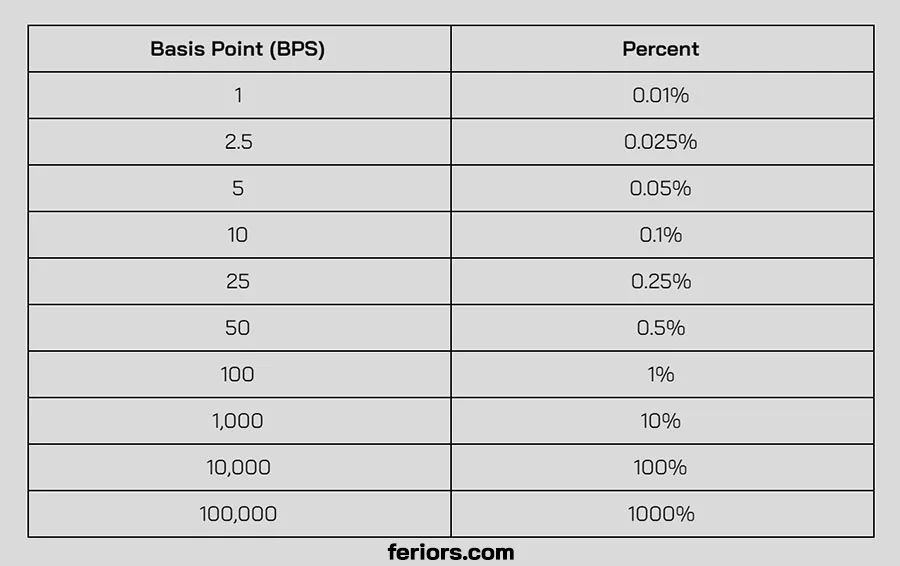
As you know, 1 BPS is equivalent to 0.01%, which mean every 1% is equal to 100 basis points.
To convert a percentage to basis point, you can calculate by this equation “Percent x 100 = Basis Points”
For example, I need to convert 0.5% to basis points, it’s will be 0.5 x 100 = 50 basis points.
At this point, you might wonder why do we really need to use Basis Point or BPS to describe the percentage change, why don’t we just tell how many percent change directly?
It’s because when someone tell you that the interest rate increased from 6% by 2% (Actually, it’s increased from 6% to 8%), this can cause confusion, because increased by 1% have another meaning.
Since 2% of 6 is 0.12, if someone said interest rate increase by 2% from 6%, this also means its increase from 6% to 6.12%.
Using basis points can solve this problem because bps or basis point is telling the percentage change directly.
From the same situation, you can says the interest rate increased by 200 basis points from 6%.
Basis Point is a unit for describe the percentage change, 1 Basis Point is equal to 0.01% (of changed percent).
To convert Basis Point to the percentage, you can calculate by divided the basis point by 100. “Basis Points ÷ 100 = Percentage”.
To calculate basis point from percentage, you can multiply the percentage number with 100. “Percent x 100 = Basis Points”.